CEX vs DEX: How Beginners Can Choose the Right Exchange
What CEX and DEX mean
In the crypto market, exchanges can generally be divided into two types: CEX and DEX.
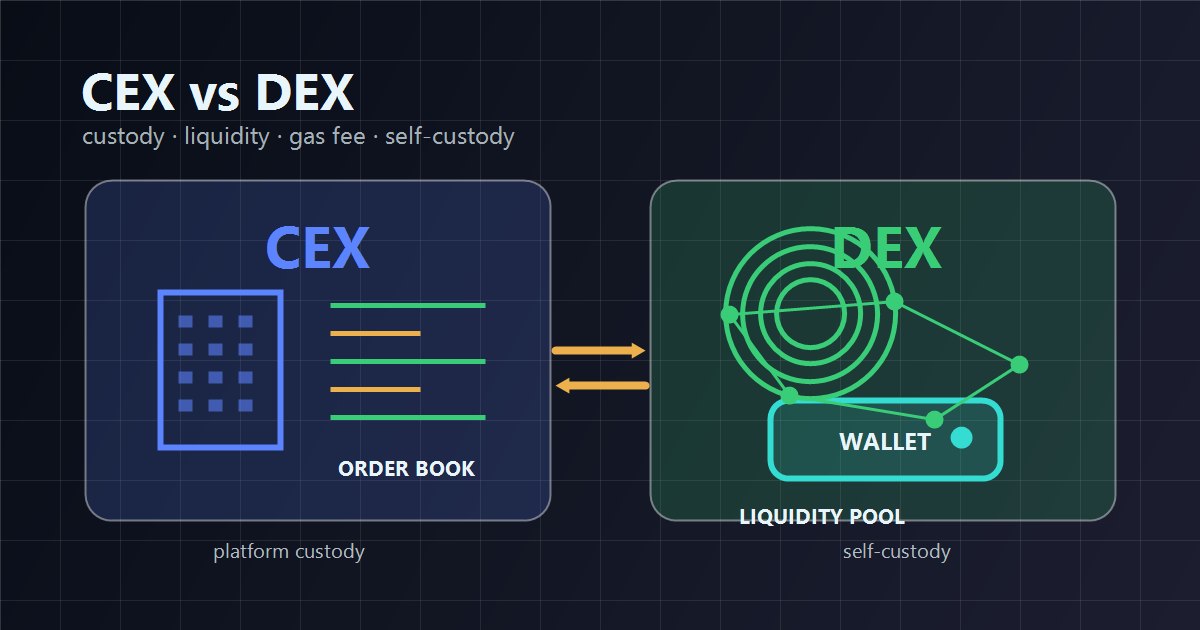
CEX means centralized exchange. You deposit assets into an exchange account, then trade BTC, ETH, USDT, or other tokens inside the platform.
DEX means decentralized exchange. Usually, you do not deposit assets into a platform account. You connect your own wallet and trade through smart contracts.
In one sentence:
- CEX: the platform holds your assets, and trading is easier.
- DEX: you hold your own assets, and trading is more self-directed.
Neither is always better. The right choice depends on your experience, goal, and risk tolerance.
Who holds the assets
The biggest feature of a CEX is custody. After you deposit assets, the platform manages your account balance. This makes the experience simple and beginner-friendly.
For example, if you want to buy BTC, you can register, deposit funds, and place an order. Many CEX platforms also offer spot, perpetual futures, earn products, copy trading, and fiat on-ramps.
The downside is that your assets are not fully under your own control. If the platform faces withdrawal limits, compliance issues, security incidents, or internal risk problems, users may be affected.
A DEX works differently. You trade with your own wallet, and your assets usually remain under your control. This follows the common crypto idea: not your keys, not your coins.
But self-custody also means self-responsibility. If you lose your private key, leak your seed phrase, approve a malicious contract, or visit a phishing site, there may be no customer support to recover funds.
Which is easier to use
For most beginners, a CEX is easier.
CEX advantages include:
- Cleaner and more familiar interface.
- Fast execution.
- Better liquidity for major assets.
- Easier access to BTC, ETH, and stablecoins.
- Account system and customer support.
If you mainly want to buy BTC or ETH, or trade mainstream perpetual futures, a CEX usually has a lower learning curve.
A DEX has more steps. You need a wallet, the correct network, gas fee, slippage settings, and the right token contract address.
For experienced on-chain users, a DEX feels flexible. For complete beginners, it is easier to make mistakes.
Liquidity and slippage
Liquidity means whether the market can smoothly absorb your buy or sell order.
CEX platforms usually have deeper order books. For major assets like BTC and ETH, execution is often faster and the price is more stable.
DEX liquidity depends on liquidity pools or on-chain order books. If the pool is deep, trading can be smooth. If the pool is shallow, you may face larger slippage, meaning your execution price differs from the expected price.
For example, you may expect to buy a token with 1,000 USDT, but low liquidity gives you a worse final price. That difference is slippage.
Large traders care a lot about liquidity. Beginners trading small tokens on DEX should also check slippage and pool depth.
Trading costs
CEX costs are usually easier to understand: maker/taker fees, withdrawal fees, and sometimes funding rate for perpetual futures.
Because trades are matched inside the platform, you usually do not pay gas fee for every trade. This is helpful for active traders.
DEX costs are more varied. Besides protocol fees, you also pay gas fee. If the network is congested, gas can become expensive. Sometimes even failed transactions still consume gas.
DEX users should also understand slippage and MEV. In simple terms, on-chain execution can be affected by liquidity, transaction ordering, and fast price changes.
If you want a simple and stable experience, CEX is easier. If you want DeFi and on-chain opportunities, you need to learn the extra costs of DEX.
Risk differences
CEX risk mainly comes from the platform. You need to trust its security, reserves, compliance, and operations.
The core CEX question is: is the platform reliable?
DEX risk mainly comes from on-chain operations and protocols. Smart contracts may have bugs, front ends may be phishing sites, tokens may be fake, approvals may be too broad, and bridges may be attacked.
The core DEX question is: can you protect your wallet and operate safely?
So it is not that one is safe and the other is unsafe. The risk types are different. CEX requires platform trust. DEX requires on-chain knowledge.
How beginners can choose
If you are new to crypto, it is usually more practical to start with a CEX. It is simpler, has better liquidity, and makes deposit and trading easier.
After you understand wallet, gas fee, slippage, approval, and DeFi, you can test a DEX with small amounts.
A practical approach:
- Use CEX for major assets and high-liquidity products.
- Use DEX to explore DeFi, early tokens, and on-chain opportunities.
- Do not keep all assets in one place.
- Test unfamiliar protocols with small amounts first.
- Improve wallet security for important funds.
For beginner and intermediate traders, CEX and DEX can work together. It does not have to be only one choice.
Conclusion
The difference between CEX and DEX is mainly a trade-off between convenience and self-custody.
CEX is easier for onboarding, mainstream trading, and liquidity. DEX is more flexible for self-custody, on-chain transparency, and DeFi opportunities.
The mature approach is not to blindly pick a side. Understand what each tool is good at, then choose based on your needs and ability.
Disclaimer: This content is for education and market research only. It is not investment or trading advice. Both CEX and DEX involve different risks. Always check platform security, protocol safety, wallet permissions, and your own risk tolerance before trading.
ARGUSBTC is a BTC perp signal detection support tool, not a trading system, and it does not automatically execute any trades. All signals are for reference only and do not constitute investment advice. Always do your own research (DYOR) and take responsibility for your own trading decisions.