What Are Perpetual Contracts? A Beginner-Friendly Guide
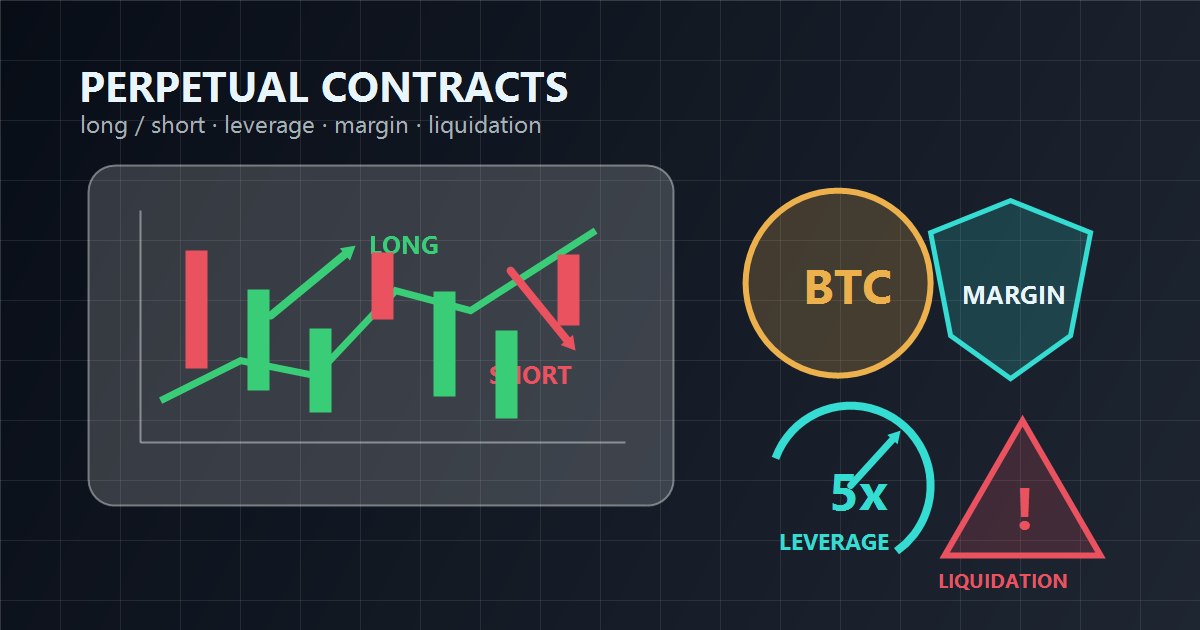
What are perpetual contracts
Perpetual contracts, often called perps, are one of the most common trading products in the crypto market. Instead of buying BTC or ETH directly, you trade the price movement of those assets.
If you think BTC will rise, you can open a long position. If you think BTC will fall, you can open a short position. When your direction is right, the position may generate profit. When your direction is wrong, it may generate a loss.
The biggest difference from spot trading is simple: spot means you buy the actual coin, while perpetual contracts let you trade price direction. You can participate in BTC price movement without holding BTC itself.
Long and short positions
For many beginners, long and short are the first confusing terms.
- Long: you expect the price to rise, so you open a position that benefits from an upward move.
- Short: you expect the price to fall, so you open a position that benefits from a downward move.
For example, if BTC is trading at 60,000 USDT and you open a long position, then BTC rises to 61,000 USDT, your direction was correct. If you opened a short position instead, that same move would create a loss.
This is why perpetual contracts are not only used in bull markets. Traders can trade both upward and downward moves. But it also means direction, timing, and risk control matter much more.
Leverage is an amplifier, not free money
One reason perps attract traders is leverage. With 1,000 USDT and 5x leverage, you can open a position with a notional value of 5,000 USDT.
That sounds powerful because a small favorable price move can increase your return. But the same rule applies to losses. A small unfavorable move can also hurt your account much faster.
Leverage does not make your judgment more accurate. It only amplifies the result. For beginners, the biggest mistake is often not being wrong about direction, but using too much leverage and too large a position.
Margin and liquidation
To open a perpetual contract position, you need margin. Margin is the capital used to support your position.
If the market moves against you, losses are deducted from your margin. When your margin is no longer enough to maintain the position, liquidation may happen. Liquidation means the platform forcibly closes your position to prevent the loss from expanding further.
In spot trading, some beginners think a loss is not real unless they sell. In perpetual contracts, that is not how it works. If the price reaches your liquidation level, the system can close your position automatically.
Before opening any position, ask yourself:
- How much am I willing to lose?
- Where is my stop loss if I am wrong?
- Is my leverage too high for this setup?
If you cannot answer these questions, it is better not to rush into a trade.
Funding rate as holding cost
Perpetual contracts have no expiry date, so they use funding rate to keep contract prices close to spot prices.
You can think of funding rate as a holding cost between long and short traders. When too many traders are long, longs may pay shorts. When too many traders are short, shorts may pay longs.
Funding rate is not a direct buy or sell signal. Its main value is showing whether one side of the market has become crowded.
For example, if BTC has been rising and funding rate keeps climbing, it may mean many traders are chasing long positions. If the market suddenly pulls back, those leveraged longs can face heavy pressure.
How beginners should use perps
If you are new to contract trading, treat perpetual contracts as a learning tool before treating them as a profit tool.
A safer starting approach:
- Use very small positions while learning the process.
- Avoid high leverage at the beginning.
- Set a stop loss before entering.
- Do not increase risk just because one trade wins.
- Avoid trading when emotions are high.
The real challenge is not clicking long or short. The real challenge is staying disciplined when the market moves quickly.
Conclusion
Perpetual contracts are not mysterious. They allow traders to trade price direction with long or short positions, use leverage to improve capital efficiency, and accept higher risk at the same time.
For beginners and intermediate traders, the priority is not chasing high returns. The priority is understanding the rules: long, short, margin, leverage, funding rate, and liquidation.
Perps are not something you must avoid, but they are also not something to use casually. Learn the rules first, control risk first, and only then think about improving returns.
Disclaimer: This content is for education and market research only. It is not investment or trading advice. Crypto assets and perpetual contracts involve high risk and may cause loss of principal. Always do your own research and manage risk carefully.
ARGUSBTC is a BTC perp signal detection support tool, not a trading system, and it does not automatically execute any trades. All signals are for reference only and do not constitute investment advice. Always do your own research (DYOR) and take responsibility for your own trading decisions.